String formulation
Co-poly blends vary widely in stiffness, energy return, and measured tension loss. “Poly” is a category, not one behavior.
Polyester starts relaxing as soon as it leaves the stringing machine. The useful question is not whether tension drops—it will—but when the measured change and the on-court response move outside your preferred window.
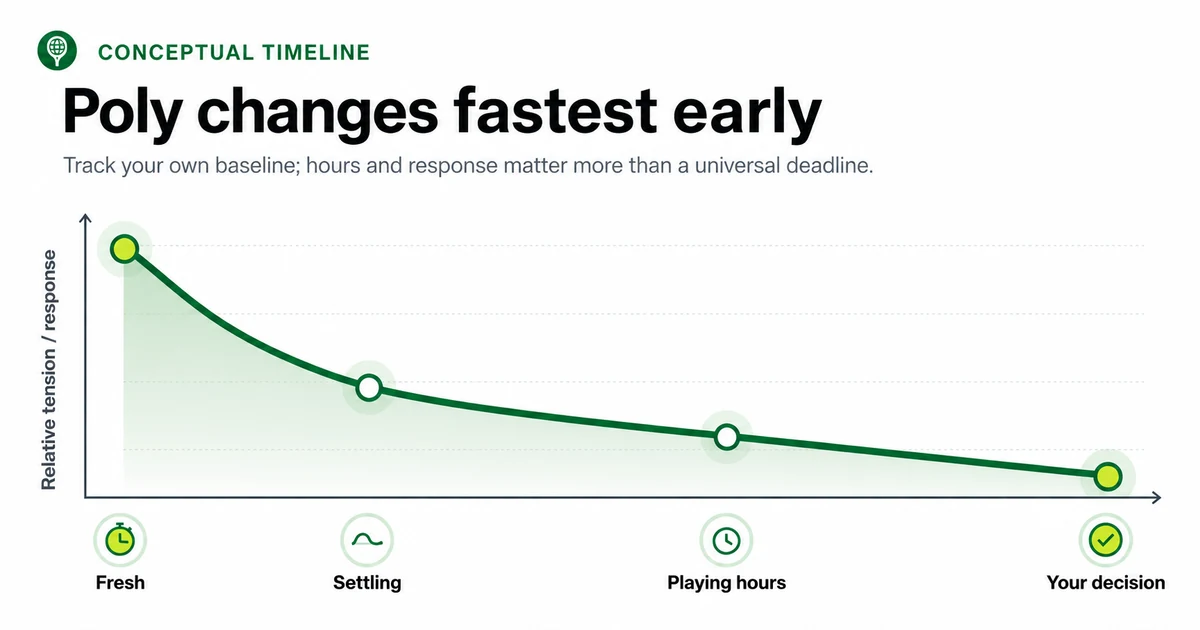
Laboratory work and string-performance databases consistently show that polyester loses tension faster than nylon. A single percentage would be misleading because string model, test method, starting tension, gauge, temperature, storage, and impacts all change the result.
| Stage | What is changing | What to do |
|---|---|---|
| Off the machine | Stress relaxation begins immediately; the stringbed settles even before the first hit. | Record string, gauge, frame, machine setting, and stringing date. |
| First 24 hours | A large share of the time-based settling happens early. | Take a repeatable fresh baseline at the same location and room conditions. |
| First 2–5 playing hours | Repeated ball impacts add dynamic tension loss and alter the stringbed response. | Recheck after a comparable session; note launch, control, sound, and comfort. |
| 5–10 playing hours | Wear, notching, and reduced string movement may become more noticeable. | Watch for multiple changes rather than replacing from one number alone. |
| 10–20 playing hours | Many recreational full-poly users enter a practical evaluation window. | Replace when the response leaves your preferred range—earlier for breakage, discomfort, or unreliable control. |
Evidence: Cross, Lindsey, and Andruczyk’s laboratory testing of tennis strings; Tennis Warehouse University’s String Performance Database; and the ITF’s technical string overview. The 10–20 hour window is an editorial planning range, not a laboratory threshold.
Tension loss is a measurable reduction in stringbed tension or stiffness from a baseline. Dead is player shorthand for an unsatisfactory combination of response changes: unpredictable launch, less snapback, a different sound, reduced confidence, or discomfort.
Tennis Warehouse University’s analysis also notes a complication: a lower-tension stringbed can return more energy even as the material changes. That helps explain why two players can describe the same old stringbed differently. “Dead” is a decision about usable response, not a universal percentage.
Co-poly blends vary widely in stiffness, energy return, and measured tension loss. “Poly” is a category, not one behavior.
Thinner or sharply shaped strings can wear and notch differently from thicker, round strings.
The machine setting changes the starting state, but it does not freeze the stringbed at that number.
Head size, string length, and open or dense patterns change movement, impact loading, and feel.
Harder, spinnier impacts usually accelerate notching and response change compared with gentle hitting.
Temperature changes stringbed response. Compare readings in similar conditions and do not store a racquet in a hot car. The temperature and climate guide covers the laboratory results.
The value is the personal curve. An app estimate, racquet diagnostic device, or stringbed frequency reading is most useful when the method stays consistent; it is not the same thing as the stringer’s machine setting.
Replace it when performance becomes consistently unreliable for you, the string is close to breaking, or play is uncomfortable. If you keep losing control after the same number of hours and your measurement shows a repeatable change from fresh, you have found a useful personal restring point.
If discomfort appears, stop playing through it. A string change may alter feel, but persistent pain deserves advice from a qualified health professional rather than a diagnosis from equipment data.
See the dead-string symptom guide for the full decision matrix, or use the cost-per-hour calculator to compare a shorter-lived poly setup with a longer-lived alternative.
To turn those signals into a personal hour range, use the poly string lifespan guide and compare each job at repeatable playing-hour checkpoints.
Choosing between materials? The poly vs. natural gut tension-loss comparison explains the category differences and lets you compare retention from your own readings.
Polyester begins relaxing immediately after stringing, with a large part of the time-based change occurring early. Ball impacts then add further change. The exact rate depends on string, gauge, reference tension, frame, temperature, storage, and play.
No. Tension loss is one measurable change. Players use dead to describe a combination of changed response, reduced snapback, launch inconsistency, feel, sound, and playing hours. Compare several signals against a fresh-string baseline.
There is no universal cutoff. For planning and cost comparison, 10–20 playing hours is a useful monitoring window for many recreational full-poly setups, but heavy hitters may replace sooner and other players may remain satisfied longer.
Not automatically. A higher machine setting does not stop relaxation and can make a stiff setup less comfortable. Stay within the racquet and string maker’s guidance, then compare small changes while keeping other variables constant.
These sources support the physical behavior described above. The playing-hour checkpoints are editorial monitoring windows, clearly separated from laboratory findings. See our research and correction standards.
Measure the same racquet over time and replace strings from evidence instead of guesswork.
Measure With String Tension AICopyright 2026 Trader Prosperity LLC. The “Polyester tension-loss timeline” graphic is published by String Tension AI. These terms apply to its full-size, responsive, and social-preview versions.
You may download the graphic for personal reference and share a link to this page. Republishing, distributing, adapting, or using the graphic commercially requires our prior written permission. Credit alone does not grant permission to republish.
When permission is granted, credit String Tension AI and link to this source page, along with any conditions included in the permission. These image terms do not grant rights to third-party material or change the terms for separate datasets.
Email [email protected] with the graphic link, where you want to publish it, your intended use, and any planned changes. We will confirm whether permission is available and any applicable conditions before you use the graphic.