Different conditions
Cold, heat, altitude, humidity, wind, and ball condition can change launch and feel without the stringbed suddenly failing. Read what heat, cold and altitude change before blaming the strings.
No single sound, reading, or bad session proves a stringbed is dead. The strongest replacement decision combines a changed measurement, enough playing hours, and repeatable on-court symptoms.
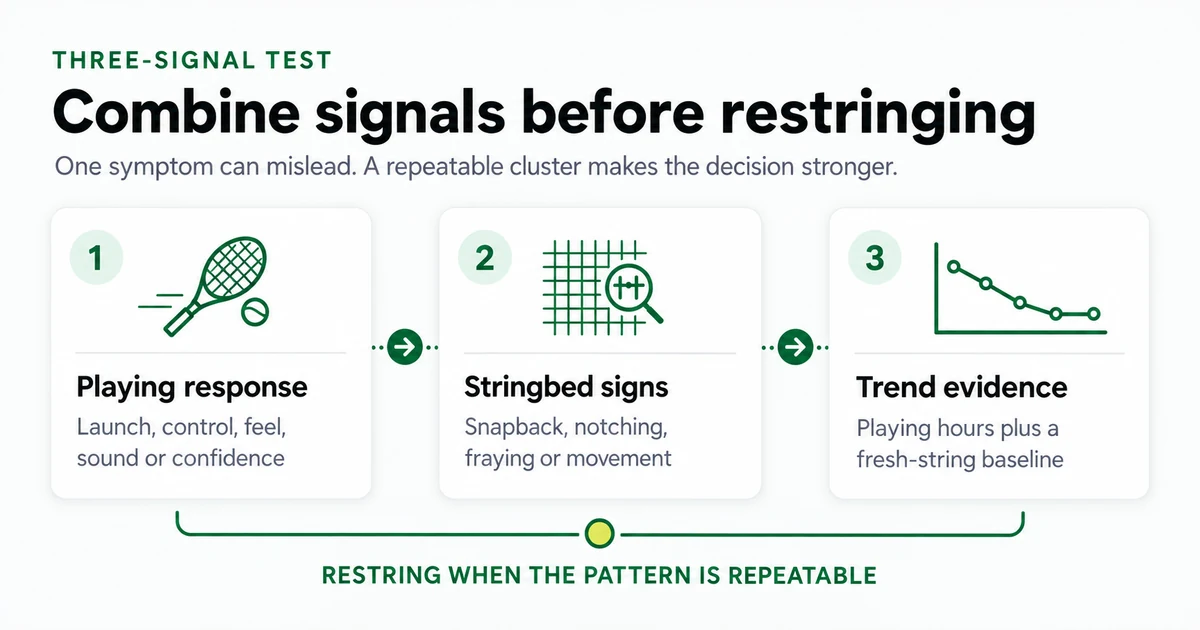
Treat each sign as evidence, not a verdict. The pattern matters more than any single symptom.
| Signal | What you may notice | Cross-check before restringing |
|---|---|---|
| Control and launch | Routine swings begin flying unpredictably long or launch higher than the same setup did fresh. | Rule out wind, tired footwork, new balls, and an isolated off day. |
| Feel and response | The bed feels unusually harsh, vague, mushy, or disconnected at familiar contact points. | Compare with the same racquet, grip, balls, and temperature where possible. |
| Spin and snapback | Mains stay displaced or the ball no longer dips as predictably on the same swing. | Check for notching and surface wear; string movement alone is not proof. |
| Sound | Impact pitch is consistently different from the fresh setup. | Measure in a similar room and account for dampeners and ball type. |
| Visible wear | Deep notches, fraying, flattening, peeling, or a string close to breaking. | Construction matters: gut frays normally, while poly often notches before breaking. |
| Comfort | A familiar setup now feels uncomfortable or requires altered swings to tolerate impact. | Stop playing through pain. Persistent symptoms need qualified medical advice. |
Technical context: Tennis Warehouse University’s dead-string analysis explains why tension loss, stiffness, and energy return do not collapse into one universal definition. The ITF’s string guide confirms that string properties change with tension loss and use.
Cold, heat, altitude, humidity, wind, and ball condition can change launch and feel without the stringbed suddenly failing. Read what heat, cold and altitude change before blaming the strings.
A dampener, grommet, trap door, or frame issue can change sound. Inspect the racquet before using pitch as evidence.
A wrong string, gauge, tension, knot, or mounting issue can make a new job feel wrong from the start. That is not age-related decline.
Fatigue, timing, technique changes, and injury can affect depth and comfort. Equipment data cannot diagnose the player.
Polyester / co-poly: Often replaced because the response, snapback, or comfort changes before the string breaks. See the poly tension-loss timeline.
Multifilament: Fraying can provide a visible clock, but performance may remain acceptable until the fibers are heavily worn or break.
Synthetic gut / nylon: Notching, movement, tension loss, and breakage can all be practical endpoints depending on the player.
Natural gut: Fraying alone is not immediate failure. Protect it from moisture and inspect for deep wear or damage.
Hybrid: Judge both components. A durable cross does not make a worn main fresh, and the two materials may change at different rates.
Record the exact string, gauge, frame, reference tension, date, and stringer. Take a fresh reading using the same method you will use later. Then log playing hours and short notes at repeatable checkpoints.
When you restring, change one major variable at a time. If the old setup became unpredictable at 12 hours, compare the next identical job at 10–12 hours before deciding whether a different string or tension is better.
The complete restring guide adds calendar-based schedules and breakage patterns. The broad tennis string lifespan by hours guide compares poly, multifilament, synthetic gut, natural gut, and hybrids; the polyester playing-hours guide goes deeper on poly. The cost calculator converts your usable-life cutoff into a fair comparison between setups.
Look for a repeatable cluster: changed launch or control, reduced snapback, different feel or sound, visible wear, and enough playing time for the setup. Compare those observations with a measurement from your fresh-string baseline.
Yes. A stringbed can leave a player’s usable performance window before it breaks. Polyester is especially likely to be replaced for response change, while natural gut or nylon may fray or break first for some players.
Not by themselves. Movement depends on construction, surface friction, pattern, notching, and tension. Persistent loss of snapback is useful only when combined with other changes and compared with how the same setup behaved when fresh.
Equipment can change impact feel, but pain has many possible causes and this guide cannot diagnose an injury. Stop playing through pain and seek advice from a qualified health professional if discomfort persists.
Laboratory findings explain the changing physical system; the three-signal test is our practical framework for applying those findings without treating one symptom as a diagnosis. See our research and correction standards.
Track tension and playing hours so your personal restring point becomes easier to recognize.
Track With String Tension AICopyright 2026 Trader Prosperity LLC. The “Dead tennis string three-signal test” graphic is published by String Tension AI. These terms apply to its full-size, responsive, and social-preview versions.
You may download the graphic for personal reference and share a link to this page. Republishing, distributing, adapting, or using the graphic commercially requires our prior written permission. Credit alone does not grant permission to republish.
When permission is granted, credit String Tension AI and link to this source page, along with any conditions included in the permission. These image terms do not grant rights to third-party material or change the terms for separate datasets.
Email [email protected] with the graphic link, where you want to publish it, your intended use, and any planned changes. We will confirm whether permission is available and any applicable conditions before you use the graphic.