When Should You Restring Your Tennis Racquet?
Forget the one-size-fits-all calendar rule. Here’s how often to restring by string type and playing hours, the signs your strings are dead, and the measurement-based trigger that serious players use instead of guesswork.
The 30-second string check
Tick everything that’s true about your racquet right now. Whether you spell it racquet or racket, your strings don’t care — but they do leave clues.
How often should you restring a tennis racquet?
It depends on your string type far more than on the calendar. Polyester goes dead fastest, natural gut holds tension longest — and every string starts losing tension the moment it leaves the stringing machine.
All strings creep under load. Industry lab testing has shown polyester typically sheds around 10–15% of its tension within the first 24 hours of stringing, before you’ve hit a single ball — and stringing-machine tests have recorded losses of many pounds within just a couple dozen hard hits. Multifilament and natural gut lose noticeably less, which is why they stay playable longer. The table below shows typical playable windows for each construction, plus what that means for a club player logging about three 90-minute sessions a week.
| String type | Typical playable window | Why it dies | Rhythm at ~4.5 hrs/week |
|---|---|---|---|
| Polyester (poly) | 10–20 hours | Loses elasticity and “goes dead” long before it breaks | Every 2–4 weeks |
| Hybrid (poly + multi) | 15–26 hours | Restring when the poly side dies — it always dies first | Every 3–6 weeks |
| Synthetic gut | 20–35 hours | Gradual tension loss; feel turns lively, then loose | Every 4–8 weeks |
| Multifilament | 25–40 hours | Frays and softens; often breaks near end of life | Every 5–9 weeks |
| Natural gut | 30–50 hours | Holds tension best; vulnerable to moisture and notching | Every 7–11 weeks |
Windows are typical club-player averages — heavy topspin, high tension, hot weather, and stiff swings push you toward the low end. Due for fresh strings? Shop strings at Courtside Tennis. Some links are affiliate links — we may earn a small commission at no extra cost to you.
For a broader comparison that separates physical durability from personal useful life, see tennis string lifespan by playing hours across string types.
The calendar rule vs. the measurement rule
You’ve probably heard the classic stringer’s rule of thumb: restring as many times per year as you play per week. Play twice a week, restring twice a year. It’s repeated by major brands and pro shops everywhere, and as a minimum, it’s fine.
As an actual decision rule, it fails three ways. It ignores string type — poly decays two to three times faster than gut. It ignores intensity and climate — a heavy topspin hitter in summer heat kills strings far faster than a doubles player in fall. And it ignores the fact that strings lose tension even sitting in your bag, so a racket strung in January is playing soft by April whether you used it or not.
The measurement rule is simpler and personal: know your fresh-string baseline, restring when readings drop roughly 8–10% below it (or when poly passes its hour cap). The calculator below estimates where you are; measuring your own racquet tells you exactly.
Restring window calculator LIVE
Estimate how much tension your strings have lost — and how many playing hours you have left before the typical restring window.
Adjust the sliders to estimate your stringbed’s status.
Add a restring reminder
Creates a calendar file with the estimated restring date and a mid-life tension check. It holds dates only, never the values you entered, and it is a planning estimate rather than a measurement.
Warning: Polyester typically loses its elasticity and “goes dead” around 10–20 hours of play — even when it hasn’t snapped and still looks pristine.
This is an illustrative estimate, not a measurement. It uses the same first-day settling and playing-hour assumptions as our tension-loss and tension-app calculators. Estimates stop at 38% loss; real strings can lose more. Later off-court relaxation, string model, gauge, climate, and swing are not modeled. Measure your own racquet to guide your restring decision.
Which clock runs out first?
Strings reach the restring window by playing hours or by the six-month floor, whichever comes first. Which clock decides depends on how many hours you play each week and on the string type.
Follows the calculator’s hours above until you move it.
| String type | Restring window | Which clock decides |
|---|---|---|
| Polyester | — | — |
| Hybrid (poly + multi) | — | — |
| Synthetic gut | — | — |
| Multifilament | — | — |
| Natural gut | — | — |
Illustrative model, not a forecast for your strings: the window opens after 9% play-driven loss (or the string’s hour cap) or at six months, whichever comes first. Measure your own racquet to see where it really is.
How fast do tennis strings lose tension?
Immediately, then steadily. Every curve below already starts under 100% because strings shed tension in the first 24 hours before you even play — polyester drops fastest, typically 10–15% before your first session.
Two takeaways matter for your restring decision. First, the steep early drop means a racquet strung the night before an event will play differently by the weekend — plan fresh string jobs a few days out. Second, the lines never flatten to zero: tension loss is continuous, so “my strings feel fine” mostly means “I’ve adapted to softer strings.” Players routinely discover they’ve been compensating for a 10%+ drop without noticing — until fresh strings suddenly feel “too tight.”
7 signs your tennis strings are dead
Dead strings rarely announce themselves by breaking. They fade — and your game quietly fades with them. Watch for these signals:
Shots flying long
Looser strings act like a bigger trampoline, launching the ball deeper with less control.
Thud, not pop
A fresh stringbed sounds crisp. A dead one sounds dull — the same acoustic change a tension app listens for.
Mushy or boardy feel
Soft strings feel spongy; dead poly turns harsh and plank-like. Either way, the response you chose is gone.
Strings stop snapping back
If mains stay shoved out of line after spin shots, the stringbed’s elasticity is fading.
Sore arm or elbow
A familiar setup now feels uncomfortable or makes you alter your swing to tolerate impact. Stop playing through pain and seek qualified medical advice if it persists.
Spin has gone flat
Less snap-back means less bite on the ball. Your usual heavy ball starts sitting up.
You can’t remember the last restring
If you have to think about it, you’re past the window. Tracking string jobs removes the mystery.
Notice that every sign is subjective except one: the sound. That’s the physics a phone can read. Feel adapts; a measured tension trend doesn’t lie. For a deeper dive into each symptom, see our guide to dead tennis strings.
Should you restring before a match?
Yes — two to four days before, not the night before. Fresh strings shed tension fastest in their first 24–48 hours, so give them time to settle and get one practice session on the new bed.
Restring ahead of a match if any of these are true: your readings have drifted 8–10% or more below your fresh-string baseline, your poly job has passed roughly 15 hours of play, or you’re seeing the dead-string signs above. A string job that’s merely “okay” in week three of league play is a liability in a third-set tiebreak.
Timing matters as much as the decision. String a few days out, hit a practice session to confirm the setup feels right, and measure once it’s settled — that post-settle reading becomes your match-ready reference. If circumstances force a same-day restring, many experienced players string a pound or two tighter than their target, knowing the early drop will bring it down to where they want it. Tournament pros restring constantly for exactly this reason — they refuse to let the stringbed be a variable.
6 restring mistakes that cost you matches
Waiting for strings to break.
Poly almost never breaks on time — it goes dead silently weeks earlier. Breakage is a deadline you should never reach.
Restringing once a year while playing weekly.
At 4+ hours a week, even durable strings are far outside their playable window within a couple of months.
Judging by eye.
Fraying lags tension loss badly, and poly looks factory-fresh while playing completely dead. Looks tell you almost nothing.
Stringing the night before a final.
The steepest tension drop happens in the first 24 hours — your “fresh” job will feel different by mid-match.
Changing string and tension at the same time with no baseline.
If you alter two variables at once and never measure, you can’t tell what helped. Change one thing, measure, compare.
Assuming every racquet in your bag matches.
Strung on different dates with different play time, two “identical” racquets can sit pounds apart. Switching mid-match shouldn’t be a surprise.
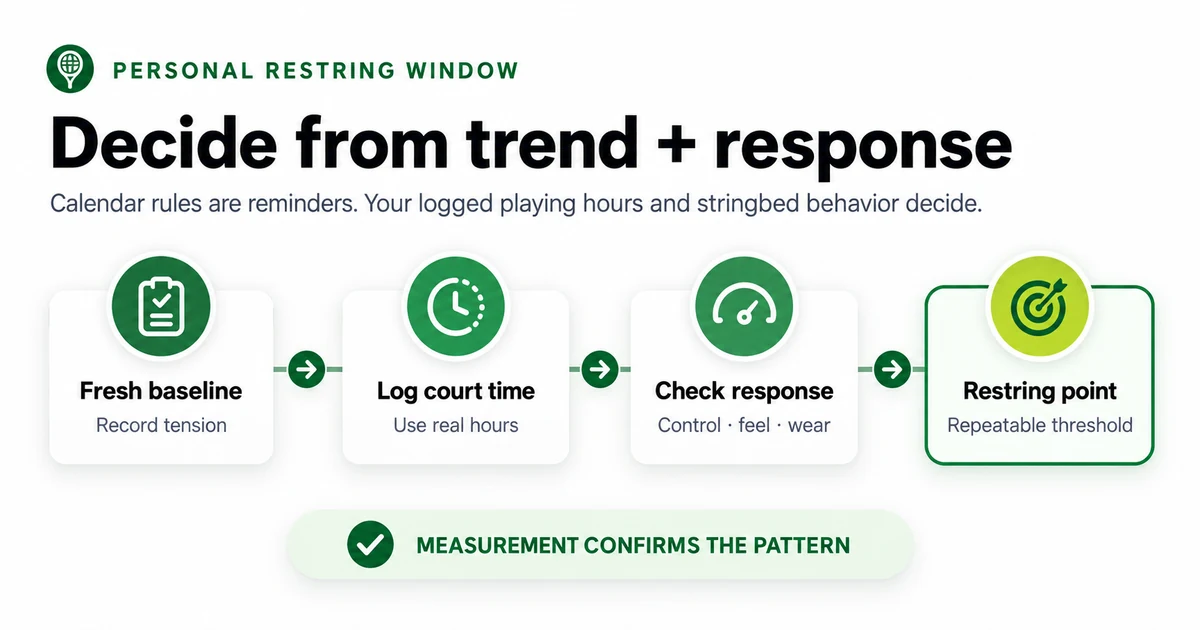
The smarter trigger: your own baseline
Charts and rules of thumb are averages. Your restring decision shouldn’t be. The method serious players use takes four steps and about ten seconds a week.
Set your baseline
Measure within a day or two of restringing, once the early settling is done. That reading is your personal “fresh” reference for this racquet and string setup.
Tap & track
After sessions, tap your strings and let audio analysis read the stringbed’s vibration. Ten seconds, no extra hardware, with quality feedback on every measurement.
Watch the trend
Tension-loss percentage plus hours played per string job tells you how your setup actually decays — not how an average one does.
Restring on signal
When readings cross your threshold — for most players, about 8–10% below baseline — you restring with confidence instead of doubt.
Stop guessing. Start measuring.
String Tension AI turns your iPhone into a string tension tracker. Build a baseline for each racquet, watch tension loss over time, log playing hours, and know exactly when it’s time to restring.
- Unlimited measurements, free — no extra hardware needed
- Fresh-string baseline, history, and tension-loss tracking
- Playing-session logging tied to every string job
- PRO adds restring reminders, the Tension Advisor, multi-racquet tracking, and cost analytics
Free to start · iPhone (iOS 17+) · Readings track relative change against your own baseline
Frequently asked questions
How often should I restring my tennis racquet?
As a minimum, restring as many times per year as you play per week — twice-a-week players restring at least twice a year. But string type matters more: polyester typically needs restringing every 10–20 playing hours, multifilament and synthetic gut every 25–40, and natural gut every 30–50. The most reliable trigger is measured tension loss, not the calendar.
How do I know if my tennis strings are dead?
Dead strings feel mushy, or harsh and boardy, sound like a dull thud instead of a crisp pop, stop snapping back after spin shots, send balls flying long, and can leave your arm sore. Because feel changes gradually, the surest check is comparing a current tension reading against your fresh-string baseline.
Should I restring my racquet if the strings aren’t broken?
Yes. Most strings — especially polyester — lose playable tension and elasticity long before they snap. Waiting for breakage means playing weeks on a stringbed that has drifted far below the tension you chose, costing you control and increasing stress on your arm.
How many hours do polyester strings last?
For most club players, polyester strings play well for roughly 10–20 hours before going dead, even though they may not break for months. Big hitters and frequent players sit at the low end of that range. Tracking hours per string job alongside tension readings shows exactly where your setup falls.
Do tennis strings lose tension if I don’t play?
Yes. Strings are under constant load, so they slowly creep and lose tension even sitting in your bag — with the steepest drop in the first 24 hours after stringing. That’s why a racquet strung months ago plays softer than its reference tension, and why twice a year is a sensible floor even for occasional players.
Should I restring right before a big match?
Restring two to four days before the match, then play at least one practice session on the fresh stringbed. Strings shed tension fastest in the first 24–48 hours, so a same-day string job can feel noticeably different by the third set. If you must string same-day, many players go a pound or two tighter to allow for settling.
Why are my shots suddenly flying long?
Falling tension is the usual culprit. As strings loosen, the stringbed gets springier and launches the ball deeper with less control — the classic trampoline effect. If your technique hasn’t changed but balls keep sailing, measure your tension before you start rebuilding your swing.
Can I check my string tension at home without a machine?
Yes. Phone-based tools like String Tension AI analyze the sound of your stringbed’s vibration when you tap the strings, giving you a reading in seconds with no extra hardware. Used consistently, that lets you track tension loss against your own fresh-string baseline — the comparison that actually drives the restring decision.
Research and guidance behind this decision framework
Published sources support the physical behavior of strings and stringbeds. The playing-hour ranges and multi-signal decision framework are practical monitoring guidance, not universal failure thresholds. See our editorial and correction standards.
- Cross, Lindsey, and Andruczyk — Laboratory testing of tennis strings
- Tennis Warehouse University — How Tennis Strings Go Dead, Part 1
- Tennis Warehouse University — How Tennis Strings Go Dead, Part 2
- International Tennis Federation — Equipment: strings
- Wilson — string-tension starting guidance
- Mohandhas et al. — racquet string tension and elbow loading
Stop guessing. Start measuring.
Your strings are changing every time you play. Measure your racquet in seconds, build your baseline, and let the trend tell you when it’s time to restring.
Free tier includes unlimited measurements · iPhone, iOS 17+
iPhone · iOS 17+ · Android coming soon — get notified below.
Not on iPhone, or not ready yet? Get product updates and Android availability news — no spam.
We’ll only use your email to send the updates you ask for — no spam. See our Privacy Policy.
Image usage and permissions
Copyright 2026 Trader Prosperity LLC. The “When to restring decision timeline” graphic is published by String Tension AI. These terms apply to its full-size, responsive, and social-preview versions.
You may download the graphic for personal reference and share a link to this page. Republishing, distributing, adapting, or using the graphic commercially requires our prior written permission. Credit alone does not grant permission to republish.
When permission is granted, credit String Tension AI and link to this source page, along with any conditions included in the permission. These image terms do not grant rights to third-party material or change the terms for separate datasets.
Request image permission
Email [email protected] with the graphic link, where you want to publish it, your intended use, and any planned changes. We will confirm whether permission is available and any applicable conditions before you use the graphic.