Historical equipment profile · Sources compared
Rafael Nadal String Tension & Setup
RPM Blast, normal versus altitude tension, the 2022 gauge report, and the distinction between his match frame and the retail Rafa Origin.
By String Tension AI · Published · Research checked
This source-based profile covers Rafael Nadal’s professional equipment, centered on his RPM Blast era and long-term AeroPro Drive / Pure Aero lineage. Nadal retired from professional tennis in November 2024. Babolat’s retail Pure Aero Rafa Origin was designed to closely reproduce his specifications but should not automatically be treated as the exact frame used in every match. This is not an official Nadal page.
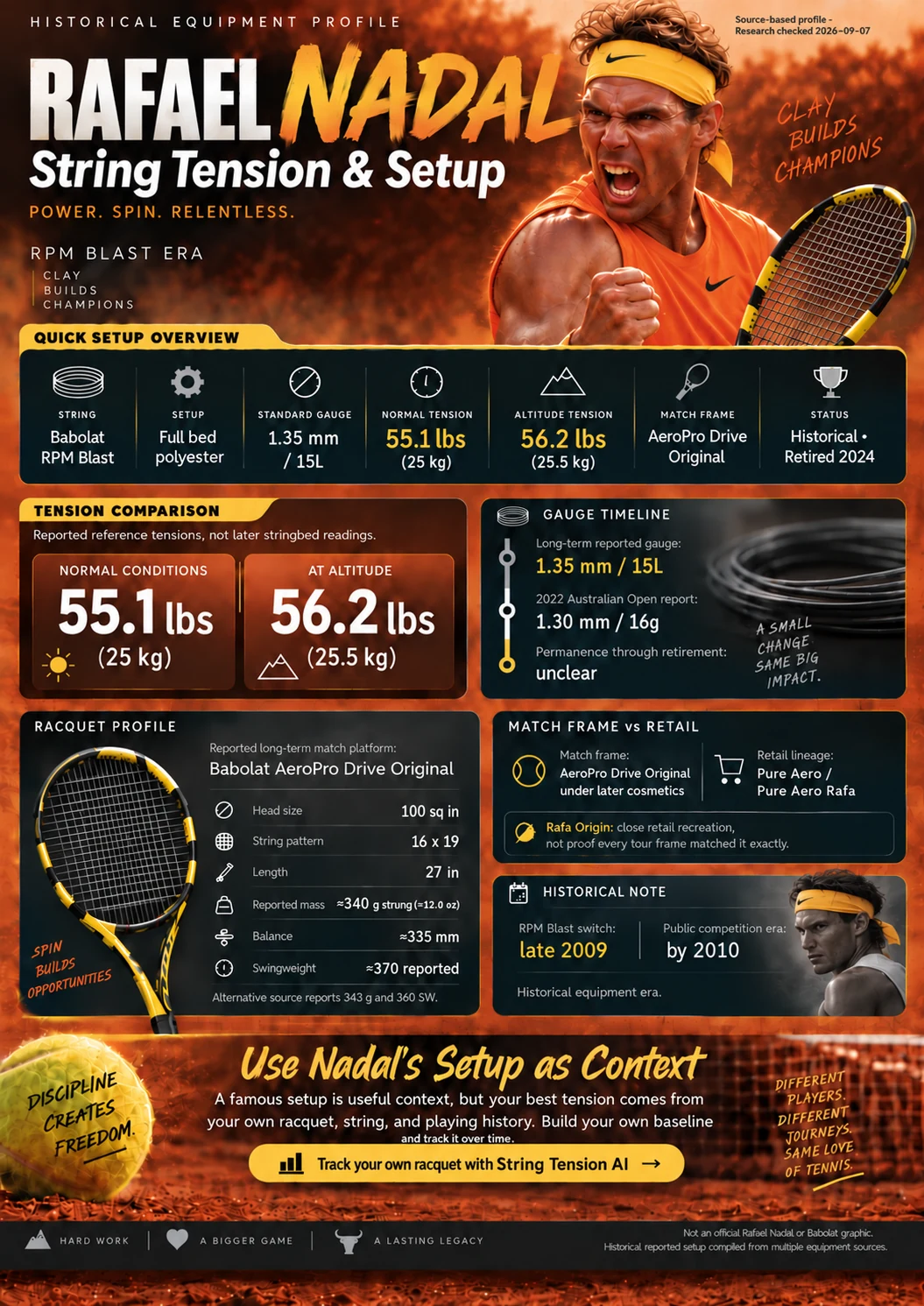
Rafael Nadal’s best-documented career setup used a full bed of Babolat RPM Blast, most commonly reported in 1.35 mm / 15L, at approximately 55.1 lbs (25 kg) in both mains and crosses under normal conditions. Babolat quotes Nadal saying he raised that to 56.2 lbs (25.5 kg) at altitude. A thinner 1.30 mm version was reportedly introduced at the 2022 Australian Open, but available evidence does not establish that it permanently replaced 1.35 through retirement. Babolat associated Nadal with the Aero/Pure Aero family, while specialist equipment sources identify his underlying long-term frame as the original AeroPro Drive platform under later cosmetics. The Pure Aero Rafa Origin was developed as a close retail recreation of his specifications; that does not prove every tour frame was an untouched retail Origin. These are historical reference settings and reported equipment snapshots, not later stringbed measurements or a prescription for your racquet.
Evidence: Babolat · Babolat · 2025-07-31 · TennisCompanion · TennisCompanion · Tennisnerd · 2026-05-21 · Babolat · 2023-05-15
Rafael Nadal’s setup at a glance
- Player
- Rafael Nadal
- Status
- Historical · retired 2024
- String
- Babolat RPM Blast
- Standard reported gauge
- 1.35 mm / 15L
- Construction
- Reported full bed polyester
- Normal reference tension
- ≈55.1 lbs (25 kg)
- Altitude reference tension
- ≈56.2 lbs (25.5 kg)
- 2022 gauge report
- 1.30 mm period; permanence unclear
- Reported match frame
- Babolat AeroPro Drive Original
- Brand / retail lineage
- Babolat Pure Aero / Pure Aero Rafa
- Reported match-ready mass
- ≈12.0 oz (340 g) strung, including accessories
- Evidence status
- Historical reported setup; source-specific frame specs
- Research checked
- 2026-09-07
View all 69 sourced pro string setups →
What strings did Rafael Nadal use?
Babolat RPM Blast 1.35 mm / 15L in a reported full polyester bed is the strongest long-term RPM Blast-era synthesis. Babolat identifies the string, Babolat corroborates Nadal’s 1.35 gauge historically, and TennisCompanion names RPM Blast in both directions.
This is a career-standard snapshot, not a claim that one string and gauge covered every stage of his professional life.
What string tension did Nadal use?
The standard historical reference setting is 55.1 lbs (25 kg) mains and 55.1 lbs (25 kg) crosses, supported by the explicit two-direction equipment table. Babolat’s Nadal quotation is the primary normal-versus-altitude tension evidence.
“55 lb” is a common rounded label. The manufacturer’s source value is 25 kg; our 55.1 lbs display is a conversion rounded to one decimal, not extra measurement precision. Reference tension means the stringing-machine setting, not a later installed-stringbed reading.
Did Nadal always string at 25 kg?
Under normal conditions, Babolat quotes Nadal saying he used 55.1 lbs (25 kg); at altitude, 56.2 lbs (25.5 kg). The specified exception is altitude. The quotation does not establish a detailed personal reason for the adjustment or a transferable formula.
There is no separate clay, grass or hard-court tension schedule in that statement. It also mentions the same weight and grip across surfaces. We do not turn it into a temperature or humidity rule, or treat the settings as permanent for every job.
Scroll the table sideways to compare all source details.
| Conditions | Reference tension | What is established |
|---|---|---|
| Normal | ≈55.1 lbs (25 kg) | Babolat: 25 kg original source value |
| Altitude | ≈56.2 lbs (25.5 kg) | Babolat: 25.5 kg exception |
Did Nadal use RPM Blast 1.35 or 1.30?
1.35 mm is the better-supported long-term and manufacturer-corroborated gauge. Babolat’s July 2025 article identifies Nadal with 1.35, and Tennisnerd’s 2026 retrospective also names it.
TennisCompanion reports a move to 1.30 mm / 16g at the 2022 Australian Open, while explicitly leaving its permanence unresolved. That report belongs in the history; it does not establish that 1.30 permanently replaced 1.35 through retirement. We retain 1.35 in the catalog and keep the reported thinner period visible here.
Scroll the table sideways to compare all source details.
| Period / report | Gauge | Evidence |
|---|---|---|
| Longstanding setup | 1.35 mm / 15L | TennisCompanion |
| 2022 Australian Open | 1.30 mm / 16g reported change | TennisCompanion |
| Post-2022 permanence | Unknown | No complete string-job chronology establishes whether the change lasted. |
| 2025 manufacturer retrospective reference | 1.35 mm | Babolat |
| May 2026 equipment retrospective | 1.35 mm | Tennisnerd |
Was Nadal’s RPM Blast setup a full bed or a hybrid?
A reported full bed. TennisCompanion’s pro-tension table explicitly lists Babolat RPM Blast as both main and cross strings at 25/25 kg. This goes beyond a single undirected product mention.
The table uses the gauge label 15; its player guide specifies 1.35 mm / 15L and Babolat corroborates 1.35. Our cross-gauge value combines those sources rather than pretending the table itself prints 1.35. The corrected public record now identifies polyester in both directions instead of leaving the cross unreported.
When did Nadal switch to RPM Blast?
Babolat’s retrospective dates the move to late 2009. TennisCompanion places the black RPM Blast publicly in competition by 2010 and describes earlier Babolat Duralast and Pro Hurricane Tour in the polyester history.
These are equipment-era boundaries, not a private stringing diary. The reported 2022 thinner gauge is a later RPM Blast episode. Nadal announced retirement in October 2024 and played his final professional match on November 19, 2024 at the Davis Cup Finals (ATP announcement; ATP farewell).
What do the string sources actually establish?
The manufacturer is unusually specific about normal and altitude tension. More detailed direction-by-direction reporting comes from the equipment table. The sources below leave unstated fields unstated; agreement does not prove independent physical inspections.
Scroll the table sideways to compare all source details.
| Source | String / gauge | Setup / reference tension | Racquet evidence | Level |
|---|---|---|---|---|
| Babolat | RPM Blast; gauge unstated | Directions not separated; 55.1 lbs (25 kg) normally / 56.2 lbs (25.5 kg) at altitude | Aero/Pure Aero family | Manufacturer / player quotation |
| Babolat | RPM Blast context; 1.35 mm | No Nadal tension or direction detail | Not used for frame specs | Manufacturer corroboration |
| TennisCompanion / pro-tension table | 1.35 standard; 1.30 report in 2022 | Explicit RPM Blast both directions; 55.1 lbs (25 kg) / 55.1 lbs (25 kg) | AeroPro Drive; 343 g / 335 mm / 360 SW | Equipment reporting |
| Tennisnerd | RPM Blast 1.35 mm | No tension or separate cross setting stated | AeroPro Drive Original; 340 g / 335 mm / 370 SW | Specialist retrospective |
What racquet did Rafael Nadal actually use?
The specialist-reported long-term match frame is the Babolat AeroPro Drive Original. Tennisnerd identifies the original platform under later cosmetics; TennisCompanion reports its 100-square-inch head, 27-inch length and 16x19 pattern.
That is more specific than the broad Pure Aero name formerly shown in our catalog. We do not infer an exact layup, permanent added-weight layout or untouched retail build from the family name.
Did Nadal actually use a Pure Aero or an AeroPro Drive?
Babolat’s official naming connects Nadal to the Aero/Pure Aero family. Tennisnerd and TennisCompanion identify his underlying long-term match platform more narrowly as the original AeroPro Drive under later Pure Aero / Rafa cosmetics.
A cosmetic design describes how a racquet looks; the platform describes its underlying equipment lineage. Those are different claims. Babolat’s retrospective dates Aero adoption to 2004, while its broader family profile uses 2003 naming. Neither should be read as proof of a modern retail model throughout his career.
Is the Pure Aero Rafa Origin Nadal’s exact racquet?
Babolat’s 2023 launch statement describes a retail design made as close as possible to his specifications across weight, balance, technology, stiffness, layup and cosmetics. It also notes small adjustments at his request, including possible surface context, and warns that professionals may use customized or different equipment.
The Origin is Babolat’s closest retail recreation of Nadal’s specification, not proof that every match frame was an untouched retail Origin. The statement about requested adjustments is not a separate surface-specific string-tension schedule.
Do not confuse the 317 g unstrung Pure Aero Rafa Origin with the 290 g unstrung Pure Aero Rafa, the lighter adult consumer version in the same launch. Pure Aero Rafa Origin — regional retail context provides the detailed retail specification.
How heavy was Nadal’s actual racquet?
Tennisnerd reports approximately 340 g strung including dampener and overgrip, 335 mm balance and 370 swingweight. TennisCompanion reports 343 g strung, 335 mm balance and 360 swingweight.
The mass disagreement is only a few grams; the swingweight disagreement is more substantial. The reports do not provide a shared measurement history that resolves why they differ. We show two source-specific snapshots, with neither swingweight declared universally correct.
Both reports describe a heavier, higher-inertia match frame than the ordinary retail Pure Aero comparison in TennisCompanion’s guide. That broad agreement does not make the individual numbers interchangeable.
Reported Nadal match-racquet specs
The catalog selects Tennisnerd’s ≈12.0 oz (340 g) reported professional strung snapshot. Its accessories remain part of that stated mass; it is not a bare strung frame or an unstrung measurement.
Scroll the table sideways to compare all source details.
| Field | Tennisnerd, May 2026 | TennisCompanion |
|---|---|---|
| Source | Tennisnerd | TennisCompanion |
| Platform | AeroPro Drive Original / 2005 platform | AeroPro Drive |
| Head / pattern | Original platform identified; geometry taken from TennisCompanion | 100 sq in / 16x19 |
| Length | Not specified in this report | 27 in |
| Mass, strung | ≈340 g including dampener and overgrip | ≈343 g |
| Balance, strung context | ≈335 mm | ≈335 mm |
| Swingweight, strung context | ≈370 | ≈360 |
No mass or swingweight average is calculated. Unknown frame-to-frame variation, source dates and measurement methods are not filled in with a made-up explanation.
Reported match frame vs Pure Aero Rafa Origin
Babolat’s UAE retail listing supplies the Origin context below. The US and UK product URLs redirected to category pages during research, so the linked regional listing is identified explicitly.
Scroll the table sideways to compare all source details.
| Field | Reported Nadal match frame | Pure Aero Rafa Origin — retail |
|---|---|---|
| Sources | Tennisnerd / TennisCompanion | Babolat UAE |
| Model / platform | AeroPro Drive Original, specialist reported | Pure Aero Rafa Origin |
| Head | 100 sq in | 100 sq in |
| Pattern | 16x19 | 16x19 |
| Length | 27 in, TennisCompanion | 27 in |
| Mass | ≈340 g STRUNG including accessories, Tennisnerd | 317 g ±7 g UNSTRUNG (11.2 oz) |
| Balance | ≈335 mm STRUNG | 330 mm ±7 mm UNSTRUNG |
| Swingweight | ≈370 STRUNG, Tennisnerd; alternative ≈360, TennisCompanion | 335 on the UNSTRUNG retail listing |
| Stiffness | No universal match-frame RA asserted here | 73 ±3 RA |
These are different measurement states. The match snapshot is strung and includes accessories; the retail values describe an unstrung product. Subtracting 317 g from 340 g would not establish customization mass. Nor should the two swingweights be subtracted to infer a modification. The listing labels its product unstrung and gives 335 swingweight; it does not publish a measurement protocol.
How did Nadal’s racquet change over his career?
Babolat describes early Soft Drive and Pure Drive use, Aero adoption in 2004, and later small weighting changes. TennisCompanion also reports a short 2015 prototype period before a return to the earlier platform.
This supports a long-running lineage with experiments and adjustments. It does not establish a single immutable frame for every season, and we do not attribute playing results to any one equipment change.
What Babolat says about RPM Blast
Babolat’s product positioning: the RPM Blast product page describes an octagonal co-polyester monofilament and emphasizes spin, durability and control. The Nadal association is well documented.
That establishes the equipment and how the manufacturer markets it. It does not establish that a 1.35 gauge caused his topspin, that 25 kg caused his control, or that copying the string will reproduce his strokes.
Should an app reading equal Nadal’s machine setting?
Both directions share the reported setting here. Use a repeatable baseline rather than treating the machine value as an app target. Read reference tension versus app estimates.
Should you copy Nadal’s setup?
There is no reason to copy RPM Blast 1.35 at 25 kg solely because Nadal used it. Very thick polyester, a reported high-swingweight frame, a 100-square-inch head, professional technique, professional string preparation and personal preferences form specific historical context.
Start with your own frame and string guidance and compare feel and playing history. Use the starting-tension calculator and tension chart to frame that decision. This profile assigns no medical effect or guaranteed performance benefit.
Track your own setup instead of copying a legend
A famous setup is context. Your useful number comes from your own history. In String Tension AI, save your racquet and RPM Blast full bed or your own string combination, then record the reference tension separately from readings.
Establish a fresh-string baseline, repeat measurements consistently, track tension loss, and compare future string jobs with play history and feel. For supported combinations, that record supports your own decisions. This does not imply Nadal used or endorsed String Tension AI.
What this means for a club player
The main reference setting shown on this page is about 55.1 lbs (25 kg). Our published starting range for a polyester / co-poly stringbed is 44–54 lbs (20.0–24.5 kg) (tension guidance reviewed ). The professional setting sits above the top of that starting range.
That comparison is context, not a target. A tour player’s reference setting reflects their own swing, frame, stringer and conditions, and it can change between string jobs.
- Look up your frame’s published range in the racquet tension range table.
- Choose your string construction and playing objective in the starting-tension calculator.
- After restringing, take a fresh-string baseline reading and judge later readings by relative change, alongside feel and hours played.
Using this infographic
Copyright 2026 Trader Prosperity LLC. The Rafael Nadal setup infographic is published by String Tension AI. These terms apply to the WebP versions of this graphic.
You may download the infographic for personal reference and share a link to this page. Republishing, distributing, adapting, or using the graphic commercially requires our prior written permission. Credit alone does not grant permission to republish.
When permission is granted, credit String Tension AI and link to this source page, along with any conditions included in the permission. These image terms do not grant rights to third-party material or change the terms for the separate JSON datasets.
Request image permission
Email [email protected] with the infographic link, where you want to publish it, your intended use, and any planned changes. We will confirm whether permission is available and any applicable conditions before you use the graphic.
Rafael Nadal string setup FAQ
What strings did Rafael Nadal use?
His best-documented RPM Blast-era setup was Babolat RPM Blast, a polyester monofilament, in a reported full bed.
What string tension did Nadal use?
Babolat quotes 55.1 lbs (25 kg) under normal conditions and 56.2 lbs (25.5 kg) at altitude. These are reference settings.
Did Nadal string at 55 lb?
55 lb is a familiar rounded label. Babolat’s original figure is 25 kg, which converts to 55.1 lbs at one decimal; the decimal adds no source precision.
Did Nadal use 25 kg or 25.5 kg?
Both: 55.1 lbs (25 kg) normally and 56.2 lbs (25.5 kg) at altitude, according to his quotation published by Babolat.
Why did Nadal use 25.5 kg at altitude?
Babolat identifies altitude as the circumstance for that adjustment. The quotation does not establish his detailed physical rationale or a general formula for other players.
What gauge RPM Blast did Nadal use?
1.35 mm / 15L is the better-supported long-term gauge, corroborated by Babolat’s 2025 retrospective reference and specialist equipment reports.
Did Nadal use 1.35 or 1.30?
Both appear in reporting: 1.35 mm as the longstanding setup and 1.30 mm in a reported 2022 change. Its permanence through retirement is unknown.
Did Nadal switch to 1.30 in 2022?
TennisCompanion reports a thinner 1.30 mm / 16g version from the 2022 Australian Open, but explicitly leaves open whether he retained it or returned to 1.35.
Was Nadal’s setup a full bed or hybrid?
A reported full bed of RPM Blast. TennisCompanion’s pro-tension table names the same polyester string in the mains and crosses.
Did Nadal use the same tension in mains and crosses?
The standard historical table snapshot is 55.1 lbs (25 kg) mains and 55.1 lbs (25 kg) crosses. This is not a log of every string job.
When did Nadal switch to RPM Blast?
Babolat dates the transition to late 2009; tournament reporting places the black string publicly in competition by 2010. An exact private restring date is not established.
What string did Nadal use before RPM Blast?
TennisCompanion identifies earlier Babolat Duralast and Pro Hurricane Tour in his polyester history. These belong to the pre-RPM context, not the retained RPM Blast snapshot.
What racquet did Rafael Nadal actually use?
Specialists identify the AeroPro Drive Original as his long-term match platform, under later Pure Aero / Rafa cosmetics. Babolat describes the broader Aero/Pure Aero lineage.
Did Nadal use a Babolat Pure Aero?
That is the official family association. Specialist reporting identifies the underlying long-term platform more narrowly as the original AeroPro Drive, rather than establishing a stock contemporary retail Pure Aero.
Did Nadal use the AeroPro Drive Original?
Tennisnerd explicitly identifies that original platform; TennisCompanion also distinguishes his AeroPro Drive from the endorsed Pure Aero. These are equipment reports.
What is the Pure Aero Rafa Origin?
Babolat’s 2023 retail recreation intended to closely reproduce Nadal’s specifications, with 317 g unstrung mass. It differs from the lighter 290 g Pure Aero Rafa.
Is the Rafa Origin Nadal’s exact racquet?
Babolat describes a close recreation and allows for requested adjustments and customized or different professional equipment. That does not guarantee an untouched retail Origin matches every tour frame.
How much did Nadal’s racquet weigh?
Tennisnerd reports about 340 g strung including dampener and overgrip; TennisCompanion reports 343 g strung. The catalog selects the 340 g snapshot, rounded to 12.0 oz.
What was Nadal’s racquet balance?
Both specialist snapshots report approximately 335 mm in the strung-frame context. This is separate from the retail Origin’s 330 mm unstrung balance.
What was Nadal’s swingweight?
Tennisnerd reports approximately 370 strung; TennisCompanion reports approximately 360 in its strung specification table. Neither is treated as universally correct for every frame.
Why do sources report 360 and 370 swingweight?
They provide different equipment snapshots without a common measurement record establishing the reason. The discrepancy remains unresolved; averaging them would invent a value.
What string pattern did Nadal use?
16x19 on the specialist-reported AeroPro Drive match frame. The retail Pure Aero Rafa Origin also lists 16x19; a shared pattern does not prove complete equivalence.
Should I copy Nadal’s 25 kg tension?
There is no reason to copy it solely because Nadal used it. His thick polyester, reported high-inertia frame and professional preparation are context; use your own frame, string guidance and preferences.
Can String Tension AI measure a full bed of RPM Blast?
For supported racquet and string combinations, it can estimate installed stringbed tension and track repeatable readings. A full-bed label alone does not guarantee support for every frame.
Should an app reading equal 25 kg / 55.1 lb?
No. A reference setting on a stringing machine and a later acoustic estimate describe different physical states. There is no universal equality between them.
How often did Nadal restring?
The sources checked do not establish a reliable exact restring frequency. Carrying multiple racquets or changing racquets during a match is not itself a restring schedule.
Did Nadal change tension by surface?
Babolat quotes 25 kg normally and 25.5 kg at altitude, with the same weight and grip across surfaces. It does not supply separate clay, grass or hard-court tensions.
When did Nadal retire?
He announced retirement in October 2024 and played his final professional match at the Davis Cup Finals on November 19, 2024, as documented by ATP Tour.
Sources and methodology
This is a historical synthesis. Manufacturer statements establish product association, normal and altitude reference settings, and retail design intent. Specialist reports supply the full-bed identification and personal-frame snapshots; they are not our measurements. The catalog retains 1.35 mm and 25/25 kg as a standard historical snapshot. The 2022 1.30 report remains editorial uncertainty; it is not substituted into the scalar fields. The cross-string correction combines an explicit two-direction table with millimeter gauge corroboration. The table’s gauge label 15 differs from the player guide’s 15L, so the numeric gauge is attributed to the latter and Babolat. See the parent catalog methodology.
All external evidence below was checked on 2026-09-07. Publication dates are shown only when supplied by the source; an access date is not a claim that an undated page was published that day. No personal racquet was inspected for this profile.
First-party manufacturer evidence
- Babolat: Rafael Nadal: historical equipment and reference settings
Player quotation: 25 kg normally and 25.5 kg at altitude. Identifies RPM Blast, Aero/Pure Aero association and November 2024 retirement. Does not specify gauge or separate directions. The page retains a 2020 publication label despite later retirement copy. Accessed 2026-09-07.
- Babolat: Giovanni Mpetshi Perricard: retrospective Nadal gauge corroboration · Published 2025-07-31
Yoann Chartron identifies Nadal with 1.35 in the RPM Blast discussion; this is historical manufacturer corroboration, not a complete string-job log. Accessed 2026-09-07.
- Babolat: Rafa 20th: Aero history and RPM Blast transition
Retrospective dates Aero adoption to 2004 and RPM Blast transition to late 2009; describes later incremental frame weighting. Equipment chronology only. Accessed 2026-09-07.
- Babolat: Pure Aero Rafa Origin launch and qualifications · Published 2023-05-15
Closest retail recreation across weight, balance, technologies, stiffness, layup and cosmetics; small requested adjustments and professional-equipment disclaimer. Distinguishes 317 g Origin from 290 g Pure Aero Rafa. Accessed 2026-09-07.
- Babolat UAE: Pure Aero Rafa Origin Unstrung — regional retail specifications
Retail 100 sq in, 27 in, 317 g ±7 g unstrung, 330 mm ±7 mm unstrung balance, 335 swingweight on the unstrung listing, 16x19 and 73 ±3 RA. US and UK product URLs redirected to category pages when checked. Accessed 2026-09-07.
- Babolat: RPM Blast 12M — product construction and positioning
Polyester monofilament, co-polyester composition, octagonal construction and manufacturer positioning around spin, durability and control. Accessed 2026-09-07.
Historical equipment reports and source snapshots
- TennisCompanion: Nadal gear: strings, 2022 gauge report and match-frame specs
Standard 1.35 mm / 15L, a reported 1.30 mm change at the 2022 Australian Open with permanence unclear, and earlier Duralast / Pro Hurricane Tour context. Reports AeroPro Drive, 100 sq in, 27 in, 16x19, 343 g strung, 335 mm balance and 360 swingweight. Accessed 2026-09-07.
- TennisCompanion: Pro tension table: both Nadal string directions
Explicit RPM Blast mains and crosses at 25/25 kg, polyester. The table calls the gauge 15; the separate player guide gives 1.35 mm / 15L. Its ATP label is read historically for retired Nadal. Accessed 2026-09-07.
- Tennisnerd: Rafa Nadal’s Racquet — Player Profile · Published 2026-05-21
AeroPro Drive Original under Pure Aero cosmetics; 340 g strung including dampener and overgrip, about 335 mm strung balance and 370 strung swingweight. Historical equipment reporting, not an active-player setup. Accessed 2026-09-07.
- ATP Tour: Nadal announces the end of his career · Published 2024-10-10
First-party tour reporting of his October retirement announcement; the following Davis Cup Finals would be his final event. Accessed 2026-09-07.
- ATP Tour: Nadal takes his final bow at the Davis Cup · Published 2024-11-19
First-party tour reporting of his professional farewell after Spain’s Davis Cup exit on November 19, 2024. Accessed 2026-09-07.
String Tension AI public data
- String catalog: dated numeric snapshot
- Racquet catalog: model context and uncertainty notes
- Editorial evidence and source links
The frame record selects Tennisnerd’s ≈12.0 oz (340 g) strung snapshot including dampener and overgrip. TennisCompanion’s separate 343 g / 360 swingweight report remains visible. No unstrung mass is inferred and no measurements are averaged. See the public racquet weight contract for weight basis and source definitions.