Measurement methods · Decision guide
Tennis String Tension App vs. Tension Meter
A phone app, mechanical tester, electronic DT device, and stringing machine can all return useful numbers. Choose by the question you need answered.
Disclosure: String Tension AI publishes this comparison. We evaluate measurement methods using first-party device documentation, independent measurement terminology, and published technical research. We do not claim that a phone app universally replaces dedicated measurement hardware.
Which should you use?
For convenient, repeatable whole-stringbed tracking with no dedicated hardware and built-in history, a phone app is a strong fit. To sample individual strings or selected positions, use a mechanical StringMeter-style tool. To follow whole-stringbed stiffness as Dynamic Tension, choose an ERT-style device. A stringing machine supplies the reference pull during installation; a proper machine calibrator checks whether it pulls the expected force. None of the finished-racquet methods should automatically reproduce the original machine setting. No method is simply more accurate until you define the quantity and reference being tested. Use one method consistently for trend tracking; do not average or force different methods into the same scale.
Name the quantity first
“Tension meter” can mean several different tools
The label alone does not tell you whether a device evaluates a local string, the assembled bed, or the machine doing the pulling. Product names below illustrate categories, not a ranking or purchase recommendation.
| Tool class | Example | Reported quantity |
|---|---|---|
| Acoustic phone app | String Tension AI | Modeled current-tension estimate from whole-stringbed vibration |
| Mechanical tester | Tourna StringMeter; GAMMA tester | Local string reading or relative-loss check, according to the device |
| Electronic stringbed tester | ERT300 | Dynamic Tension / whole-stringbed stiffness |
| Stringing machine | Electronic, crank, or drop-weight machine | Reference pull during installation |
| Machine calibrator | GAMMA Tension Calibrator | Machine pull-force check |
String tension app vs. meter: side-by-side
Start with the output you want to follow. Hardware size and the presence of a pounds scale do not define the measurement.
| Method | Scope | Output | Extra hardware | Best fit | Key limitation |
|---|---|---|---|---|---|
| String Tension AI / acoustic app | Assembled stringbed | Modeled estimate in lbs (kg), saved history | iPhone; no dedicated accessory | Frequent personal tracking with racquet context | Setup, model, and capture conditions matter; cannot reconstruct machine reference |
| Tourna StringMeter | Selected local strings | Local lbs (kg) reading | Mechanical accessory | Position checks and string-job consistency | Location and technique matter; one position is not the whole bed |
| GAMMA String Tension Tester | Physical string sampling | Relative loss; 0–70 lbs scale | Spring-operated accessory | Repeated loss checks | Manufacturer describes relative use; do not assume Tourna’s method applies |
| ERT-style DT device | Whole stringbed | DT / stiffness, kp/cm; also expressible in N/mm | Electronic measuring device | Consistent DT targets and stiffness tracking | Different quantity from pull force or an app’s tension estimate |
| Stringing machine | Individual pulls during installation | Reference lbs (kg) | Full stringing equipment | Specifying and reproducing a job | Not a later measurement of the finished bed |
| Calibration scale | Machine tensioning system | Pull force | Machine calibration accessory | Checking machine calibration | Does not measure the racquet stringbed |
Documented product uses: String Tension AI, Tourna, GAMMA tester, ERT DT, and GAMMA calibrator. “Best fit” is our workflow interpretation of those uses, not experimental superiority evidence.
Same racquet. Different measurement questions.
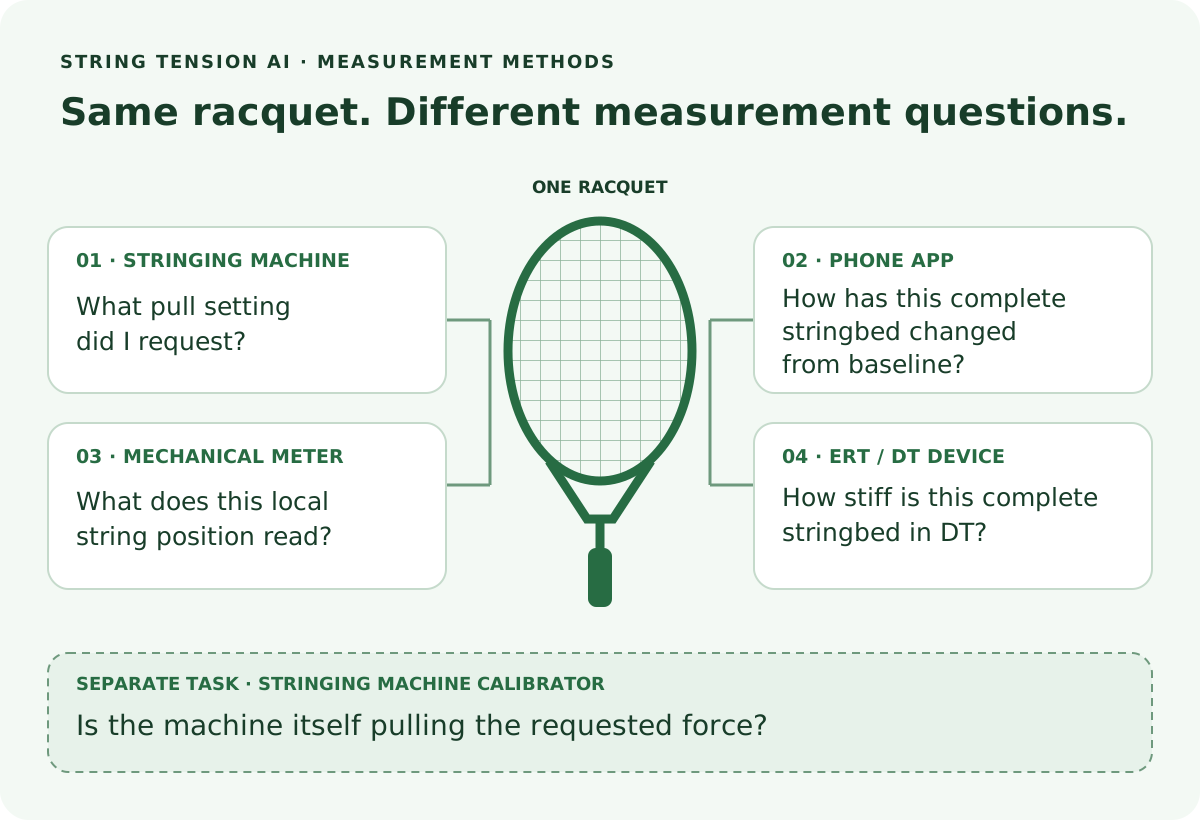
One racquet · Four questions
How has this complete stringbed changed from baseline?
What does this local string position read?
How stiff is this complete stringbed in DT?
Is the machine itself pulling the requested force?
Where a phone tension app is most useful
Choosing between phone apps? Compare current tennis string tension apps by platform, history and workflow.
An acoustic app fits the player who wants to check the complete racquet regularly and keep the results together. String Tension AI combines microphone-based stringbed vibration with setup information to produce a modeled current-tension estimate for the installed stringbed. Its useful workflow is measurement + history + context.
Saved readings, racquet/string records, and playing sessions let you revisit a fresh-string baseline and relate later change to use. Quality coaching and calibration support a consistent routine. No dedicated tension-testing accessory is needed beyond the iPhone. These features are documented in the current App Store listing and product overview.
A phone app’s practical advantage is combining repeated measurements with saved racquet history. That does not establish superior measurement accuracy over dedicated hardware. Follow the measurement procedure and tap guidance for the how-to details.
App-category context: RacquetTune’s App Store description also documents tap-sound analysis, tension/stringbed-stiffness outputs, and racquet history. It explicitly distinguishes in-racquet tension from the stringing-machine setting. This corroborates category workflow, not an app-versus-app ranking or validation of String Tension AI.
Where a mechanical tension tester is most useful
A standalone mechanical accessory fits physical spot checks without relying on a phone microphone. Different products have different designs; do not transfer one manufacturer’s procedure or claims to every tool called a tension tester.
Tourna’s current instructions place the pins at a string intersection, then rotate the unit into alignment with a main. Tourna recommends multiple main-string readings and repeat checks after play for tension loss and string-job consistency. It also lists a gauge-measuring feature and lbs/kg readings.
GAMMA’s String Tension Tester is described specifically for relative tension loss over time. Its spring movement and 0–70 lbs scale illustrate why a dedicated device can be a tracking tool without being a reconstruction of the stringing-machine setting.
A local reading is not the same as a whole-stringbed reading
Local readings can vary across a racquet. Cross and Bower discuss a Stringmeter’s localized action and variation between strings and along a string. That technical context supports treating the selected position as part of the measurement definition; it is not a current laboratory benchmark of either product above.
Make the locations repeatable. Use the same positions each time and record multiple positions when instructed. One local main-string result cannot describe every main, every cross, or the complete stringbed.
ERT measures stringbed stiffness, not the machine’s pound setting
ERT’s manufacturer calls its result Dynamic Tension (DT). Physically, it defines the force needed to briefly deflect the stringbed by 1 cm. That makes DT a whole-stringbed force-per-deflection quantity: stiffness.
The DT definition and technical FAQ use kp/cm and N/mm as stiffness units. They are units of the same dimension, not a reason to relabel a DT result as pounds of string pull. We use “whole-stringbed Dynamic Tension / stiffness” wherever marketing wording such as “actual tension” could otherwise obscure the quantity.
A DT device fits a player, coach, or stringing workflow already organized around whole-bed stiffness targets. Keep the device’s placement and procedure consistent. That record answers a different question from an app’s modeled tension estimate or a mechanical tool’s selected string position.
Stringing-machine reference tension is a different number
Reference tension is the requested machine pull during installation, normally recorded in lbs (kg). It is part of the recipe for reproducing a string job. It is not a promise about the finished racquet’s later app estimate, local reading, or DT.
Cross and Bower’s vibration-frequency research distinguishes pull tension from the installed string state and describes relaxation, frame distortion, friction, and installation effects. It does not establish one correction factor for every racquet. See the accuracy guide’s quantity definitions for depth.
If you are choosing what to request for the next job, the reference-tension calculator addresses that separate decision. Keep the requested settings with the setup record.
A machine calibrator checks the machine, not the racquet
A calibration scale checks whether the machine produces the expected pulling force. GAMMA describes its Tension Calibrator for that task, and its machine-maintenance guidance calls for a calibration scale when checking or adjusting calibration. Follow the machine’s own instructions.
If your question is “Is my stringing machine calibrated?” neither a phone tension app nor a racquet StringMeter is the correct primary tool. Use a proper machine calibration device. App setup calibration is a different operation and does not check the machine.
Which is more accurate: an app or tension meter?
Neither category is universally more accurate without defining the quantity you want to measure and the reference you are comparing against. A local string reading, modeled whole-bed estimate, stiffness value, and reference pull cannot be ranked simply because they all display numbers.
Physical contact does not automatically establish accuracy. Measuring the whole bed does not automatically establish it either. Ask whether the method addresses your question repeatably enough for the decision. NIST terminology distinguishes agreement with a reference from consistency under repeated conditions.
For the full distinction between accuracy, repeatability, uncertainty, and app calibration, read tennis string tension app accuracy. This page helps choose a method; it does not supply a new accuracy certification.
Can you compare an app reading with a StringMeter or ERT?
Do not assume numerical interchangeability. Scope, physical quantity, units, models, calibration assumptions, and timing can all differ. There is no universal app-to-StringMeter offset, DT-to-pounds equality, or percentage deduction from reference tension.
ERT supplies a DT Disk for an approximate, head-size-dependent tension estimate. Treat that as manufacturer workflow guidance, not a universal physical equality or proof of the machine’s original setting. Keep the original DT record.
You do not have to choose only one method
The following are String Tension AI workflow suggestions, not published claims that one combination outperforms another. A player might use an app for frequent history and a mechanical meter for optional local checks. A home stringer can use a calibrator for the machine and a selected post-stringing method for racquets. A coach or shop might standardize a hardware procedure while maintaining player/racquet history in an app.
Keep a separate baseline for each method
- Fresh job: record the reference settings, setup, date, conditions, and elapsed time since stringing. Save app baseline A0, mechanical baseline M0 with its positions, and DT baseline D0 if using those methods.
- Later checks: repeat each procedure under comparable conditions. Save A1, M1 at the same positions, and D1, together with play and timing context.
- Compare within each record: A1 with A0; M1 with M0; D1 with D0. Do not average A, M, and D. Their percentage changes are not guaranteed to match.
The racquet tension checker can compare current and baseline tension readings from the same method in lbs or kg; do not enter DT as pounds. For interpreting change alongside feel and use, see tension-loss tracking.
Which tool fits your question?
| Your question | Best-fit method |
|---|---|
| How has my racquet changed since it was freshly strung? | The same repeatable app or other tracking method used for its baseline |
| I want no extra measuring hardware. | Phone app |
| What do several local main strings read? | Mechanical StringMeter-style tester |
| What is my complete stringbed stiffness in DT? | ERT-style device |
| Did my stringer request 52 lbs? | Record and confirm the reference setting with the stringer |
| Is my machine pulling 52 lbs accurately? | Machine tension calibrator |
| Are two racquets behaving consistently? | The same method on both, chosen for the quantity of interest; compare like setups |
| Can I prove my stringer made an error? | No single post-stringing reading alone |
Want the tracking method that lives on your iPhone?
Measure the same racquet consistently, save a fresh-string baseline, and follow the trend over time.
Track My Racquet FreeCan an app or tension meter tell if a stringer made a mistake?
One post-stringing reading cannot prove an incorrect reference setting, machine miscalibration, poor workmanship, or a defective job. It can flag a difference worth checking: an unusual trend, local inconsistency, or whole-bed change between like racquets.
Repeat the measurement, verify setup inputs, compare like jobs at similar checkpoints, and discuss the records with the stringer. If machine calibration is the issue, test the machine with a calibrator. A racquet measurement supplies context for that conversation, not a verdict about the stringer.
What about hybrid stringbeds?
A hybrid may combine different main/cross materials, gauges, and reference settings. An acoustic estimate describes the assembled bed; it does not separately report installed mains tension, crosses tension, or their arithmetic mean. A local mechanical method samples the strings and positions allowed by its instructions. A main-string reading does not establish the crosses’ state. ERT reports whole-bed DT.
52 lbs mains + 50 lbs crosses does not create a guaranteed 51 lbs post-stringing target. Those are two reference settings. A later app estimate, local reading, or DT result answers a different measurement question.
Store both requested settings separately. Use the hybrid string tension guide for setup decisions and the accuracy guide for interpretation.
How String Tension AI fits into the workflow
Use the app to connect repeatable readings with the racquet, string setup, playing sessions, and restring history. Current public documentation lists unlimited Free measurements for one racquet with recent history; PRO adds complete history and comparison tools. See the full product and tier description for details. The role here is persistent tracking context, not a claim that hardware is unnecessary for every task.
String tension app vs. meter FAQ
For detailed accuracy and repeatability definitions, use the measurement trust guide.
Is a tennis string tension app accurate?
A modeled estimate can support useful tracking when setup information and capture conditions are consistent. Accuracy must be evaluated against a defined quantity and reference. This comparison establishes no universal error bound for an app.
Is a tension meter more accurate than a phone app?
Not as a universal statement. Local string readings, whole-stringbed estimates, and DT describe different quantities. For tracking, first establish that you can repeat the same method; agreement with another device is a separate question.
What does a tennis StringMeter actually measure?
A StringMeter-style tool samples a selected string position through physical contact. Treat that result as local information, not automatically the tension of the complete racquet. Designs and instructions differ between products.
Does the Tourna StringMeter measure stringing-machine tension?
Its local reading on a finished racquet is not a reconstruction of the original machine pull setting. Keep that reference setting in the string-job record separately.
What does the GAMMA String Tension Tester measure?
GAMMA describes its spring-operated tester as a tool for relative tension loss over time, with a 0–70 lbs scale. That stated purpose does not establish machine-setting equivalence.
What does the ERT300 measure?
ERT300 reports Dynamic Tension: the whole stringbed’s resistance to a brief deflection. It is a stiffness quantity, expressed in force per distance, rather than an individual string’s pulling force.
Is Dynamic Tension the same as pounds of string tension?
No. DT describes stiffness, with units such as kp/cm or N/mm. Pounds of pull describe force. Changing the unit label cannot make these the same physical quantity.
Can a tension app replace an ERT?
An app can meet a player’s need for repeated personal tracking, but its tension estimate does not replace a specified DT measurement. Keep an ERT-style method when DT is the quantity your workflow requires.
Can an app replace a mechanical StringMeter?
It can meet a whole-stringbed tracking goal without a dedicated accessory. It cannot supply the same local string-position information as a mechanical sampling method.
Can a mechanical meter replace an app?
It can support local checks without a phone. If saved racquet history and playing context matter, keep those records separately or use an app that provides them. The choice depends on the workflow you need.
Can I compare an app reading with a StringMeter reading?
You can keep both records, but do not assume their values are interchangeable. Compare each with its own baseline, using the same app setup and the same mechanical locations. Do not average the results.
Can I convert DT to string tension?
There is no universal DT-to-pounds equality. ERT’s DT Disk offers manufacturer guidance using head size and DT to estimate a tension value; it does not turn stiffness into an identical machine-reference measurement.
Can I convert an app reading to machine reference tension?
No universal conversion reconstructs the original machine setting from a later app estimate. Record the requested reference tension when the job is done; do not infer it from a fixed offset or percentage.
Which tool is best for tracking tension loss?
Use an app for repeated whole-stringbed estimates and history, a mechanical tester for repeatable local or relative-loss checks, or ERT for DT change. Choose the quantity you want to follow and stay with the same method.
Which tool should a home stringer use?
Use a calibration scale to check the machine’s pull. For completed racquets, choose an app, local tester, or DT device according to the information needed. More than one can be useful if their purposes and baselines stay separate.
Which tool should a tennis player use?
For routine tracking without an extra measuring accessory, a phone app is a practical fit. Choose a mechanical tester for local checks or a DT device when whole-bed stiffness is your target. Include feel, wear, and playing hours in restring decisions.
Can I use an app and StringMeter together?
Yes. Establish both baselines on the fresh job and repeat each method consistently later. Keep the records side by side, without requiring the values or their percentage changes to match.
Can an app or meter check whether my stringer made a mistake?
An unexpected reading can prompt a repeat check and a conversation. It cannot alone prove wrong reference tension, machine miscalibration, or poor workmanship. Verify setup details and compare like jobs before drawing conclusions.
What should I use to calibrate a stringing machine?
Use a suitable machine tension calibrator or calibration scale, following the machine manufacturer’s procedure. A phone app or a meter placed on a finished racquet does not directly test the machine’s pulling force.
Can a phone app measure a hybrid stringbed?
String Tension AI supports hybrid setup information and a modeled estimate for the assembled stringbed. It does not separately report installed mains and crosses tension or their arithmetic mean. Preserve both original reference settings.
Why do different tension tools show different numbers?
They may measure different quantities, sample different parts of the racquet, use different models or calibration assumptions, or be used at different times and conditions. A disagreement is a reason to identify the method, not automatically declare a faulty tool.
Sources and methodology
Documentation checked September 7, 2026. String Tension AI publishes this comparison and benefits from app downloads. Product claims below are first-party descriptions of stated use, not independent validation. String Tension AI did not independently laboratory-test these devices against one another for this article. We publish no accuracy scores, error margins, or device rankings.
Independent measurement terminology
NIST Technical Note 1297, Appendix D1: quantity/reference framing and the distinction between accuracy and repeatability.
Peer-reviewed technical research
Cross and Bower, “Measurements of string tension in a tennis racket,” Sports Engineering (2001): pull versus installed tension, string-plane vibration, local sampling, and installation effects. Historical technical context, not a test of today’s app or hardware lineup.
Manufacturer documentation
- Tourna StringMeter: operating directions, measurement positions, units, and stated uses.
- GAMMA String Tension Tester: relative-loss purpose and scale.
- ERT Dynamic Tension definition, technical FAQ, and ERT300 product documentation: DT and its intended stringbed workflow.
- GAMMA Tension Calibrator and machine-maintenance guidance: machine pull-force checking.
- String Tension AI App Store listing and public product overview: supported features. Our accuracy guide supplies the site’s measurement terminology and claim boundaries.
Competitor app-category context
RacquetTune App Store listing: acoustic measurement and history features. Developer-supplied category evidence, not independent comparative testing. Retailer documentation was not needed for this article.
The tables’ suggested uses and separate-baseline protocol are our synthesis. No prices, review counts, or purchase-value ratings inform the decision. Browse the Resources library for the procedure, accuracy, setup, and restring questions that have their own guides.
Turn measurements into history
String Tension AI connects repeatable readings with your racquet, string setup, playing sessions, and restring history.
Download String Tension AI Free